BH is rather cross that BBC are, or certainly want, to withdraw what she knows as the red button news service. A news feed which serves her, as a person whose smart phone lives in its box, well.
This morning she found a news item, the headline to which said 'Epsom Derby moved to July', or words to that effect. Which we thought a bit odd: the Epsom Derby draws in hundreds of thousands of people from all over the country, by no means all young, to squash them into a small part of the Downs and the surrounding hostelries - of which I am sorry to say that South Hatch is no longer one. A place which used to make a very convenient comfort break on the way up or on the way down. The service was good, the beer was good and they took bets. And not too many people seemed to know about it.
But such a squash, even in what might conceivably turn out to be the aftermath of the current epidemic, does not seem like a good idea at all. And it is hard to see how you could run the race at all, on what is a very open (and a very special, rather difficult) course, without lots of people turning up to watch.
I asked Bing, and the story there seemed to be cancellation, rather the postponement. Digging deeper, I got to reference 1, which talks of the next Derby meeting being planned for 2021, with very vague talk of perhaps something being possible later this year. I failed to find any reference to July.
In any event, I can't see it happening myself. If for no other reason, than that a trainer is not going to want to work his prize horse up to racing pitch for some uncertain, not to say unknown, date late summer. He - or she - is just going to coast until the coast becomes clear, as it were.
Which all goes to show that headline news, even from the BBC, can be misleading. Not many stories can be decently captured in six words - or even 250 characters, thought to be the Twitter limit - where brevity, rather than truth, is of the essence.
PS: along the way I found that the websites of both the 'Daily Mail' and the 'Daily Mirror' are so festooned with animated advertisements as to make them unusable, at least by me. And worse than the flickering, some of them even burst into sound.
Reference 1: https://www.thejockeyclub.co.uk/epsom/events-tickets/epsom-derby/.
Reference 2: https://www.thejockeyclub.co.uk/the-racing/racing-news/2020/03/british-horseracing-suspended-until-the-end-of-april/.
Reference 3: https://www.britishhorseracing.com/. 'The British Horseracing Authority has confirmed that all horseracing in Britain will be suspended with effect from Wednesday 18 March until further notice'. From the horse's mouth, as it were.
Sunday, 19 April 2020

Folding cloth

So the other morning, I was very struck by the pattern made by the trim along the edge of our eiderdown, particularly when one moved it about slightly by moving one's toes about slightly.
As it happened, on opening up gmail a little later, there was a piece in the Kurzweil newsletter about the people at reference 2, also interested in the patterns you can get in cloth and other materials, in their case computer generated. So it is not just me.
The eiderdown pattern is made very simply, as can be seen in the foreground of the snap, by taking a tuck in the strip of cloth, used to trim the edges of the quilted rectangle, of a quarter inch or so every inch or so.
Digressing, the people at reference 4 make eiderdown look ridiculously expensive. Just imagine spending your working day picking bits of dead twigs and dead leaves out of the fluff taken out of ducks' nests.
So given that our eiderdown came to us via the Saturday Telegraph, from which a good proportion of the special offers to readers are pretty tatty (although this particular eiderdown has served very well), I was not surprised to find that it was not an actual eiderdown at all, merely eiderdown like, from the people in Fife at reference 5. That said, it was natural feather, without any further qualification that I could find, so I was unable to find our eiderdown (aka quilt) on today's website. Was it goose, Hungarian or otherwise? Was is duck? Was it ecological duck? Was it down or was it feather? Could one decently say that no ducks or geese had been harmed during the production of this quilt?
Did the sort of middle class people that George Orwell wrote about, at the time our parents were growing up, always call their quilts eiderdowns in order to make them sound posher and more expensive than they really were? So that eiderdown has come down to me as a word for quilt, without any particular connotations or associations at all.
Reference 1: https://psmv2.blogspot.com/2015/09/abstract-expressionism.html.
Reference 2: https://www.zeitguised.com/.
Reference 3: https://www.zeitguised.com/neuralgroove#neuralgroove-1.
Reference 4: https://www.downduvet.co.uk/eiderdown.html.
Reference 5: http://www.euroquilt.co.uk/.
Saturday, 18 April 2020
Pivoting bricks

Sufficiently pleased with myself that I thought I would have a go with the dancing waters to wind down, and that was on good form too, and I was getting good results from all four ordinal points. Plenty of droplets rising to more than thee inches and probably some to more than six. Maybe a third of the surface area in action at peak. Maybe the clue was slightly warmer water than usual.
But the attempt to record the story of the bricks as a pivot table in Excel was frustrating. Forming the table left was fine, but when I tried to produce a graphic - de rigueur in this graphic age - it either did a polished job (top right) of what I did not want, insisting on treating the pivot table as an indivisible unit and including all three variables - or it did a crude job (bottom right) of what I did want by doing a paste special on the distance column off snap to the right.
And then there is the irritation of having to score a fake shift for the 30th March so that the row does not disappear from the table left altogether, thus disturbing the graphics right.
Maybe I will get the hang of some more of it tomorrow.
The good news is that I seem to be drifting up to somewhere near my daily target of 6,384 yards.
Series 1, Episode III
Last night, Grandpa told Yuri and his friends a very exciting story about the slugs who lived in the compost bin at the bottom of the garden. About how they were busy all day in their tunnels down under and how, during the night when the baby slugs were all asleep and tucked up in bed, they came out to play on top. They looked around for fresh, tasty snacks which had been delivered by the humans during the day. They went visiting, they sang, they danced - and they left interesting tracks - tracks which could still be seen in the morning.
So Yuri, Pedro, Polly and Baby Bear decided that next morning they would sneak down to the bottom of the garden and see for themselves. They got up very early, didn't bother with brushing their teeth or anything like that, crept downstairs, nipped out through the cat flap and set off down the garden, picking up the digging sticks on the way.


Pedro and Polly were sensible. They stuck their diggings sticks into the compost so that they could lean right over and have a good look at the compost. Count all the bugs and beetles and things. But Yuri wouldn't wait for his turn and jumped right in and tried to look down the entrance of one of the tunnels. It was a good thing that he has his space suit on, because this meant that they would be able to hose him down when they got back to the house. If he got back to the house. What would happen if one of the big slugs heard all the noise and decided to come back on top to have a look? Slugs which were more or less as big as he was. Maybe even bigger and very hungry. At which point, Yuri decided that enough was enough and it was time to get out. Pedro and Polly helped to haul him out.
Baby Bear had not managed to get all the way up the wall of the compost heap and so he had just watched from a safe distance.

Even so, he was tired out by all the excitement, and he had to sit down on his special seat to have a rest on the way home.
And by the time that they had hosed Yuri down, they were all rather late for breakfast.
Reference 1: http://psmv4.blogspot.com/2020/04/series-1-episode-ii.html.
Group search key: wwwy.
So Yuri, Pedro, Polly and Baby Bear decided that next morning they would sneak down to the bottom of the garden and see for themselves. They got up very early, didn't bother with brushing their teeth or anything like that, crept downstairs, nipped out through the cat flap and set off down the garden, picking up the digging sticks on the way.


Baby Bear had not managed to get all the way up the wall of the compost heap and so he had just watched from a safe distance.

And by the time that they had hosed Yuri down, they were all rather late for breakfast.
Reference 1: http://psmv4.blogspot.com/2020/04/series-1-episode-ii.html.
Group search key: wwwy.
Friday, 17 April 2020
A family with troubles

This being notice of the book at reference 1, picked up from a chance encounter earlier in the month with the free part of a book review in the New York Times. The author is an established journalist, with a couple of other successful books to his name and with a great deal of work, over several years, with the Galvin family, their diaries and their records going into this one. A family sadly afflicted with a great deal of mental illness. A work loudly proclaimed as being a work of non-fiction despite the fact that many books of this sort do join up a lot of the dots. Lady protesting again, as in reference 11?
In the book, we have some introductory material followed by three parts made up of 45 generally short chapters, a number of which are digressions into the progress of research into and treatment of schizophrenia. Part one: chapters 1-17: from the beginning to the father’s retirement from public work after a stroke. Part two: chapters 18-40: to the mother’s death. Part three: chapters 41-45: aftermath.
An easy & interesting read, which could probably have been a lot shorter with tighter editing. The book is roughly chronological, but only roughly. The chapters generally focus on an individual or on a topic which means there is some jumping around. The book could have done with a pull-out diagram, time line across, family member down – the sort of pull out that you can read while keeping the book open at your place. And another one about the progress of relevant medical research. But I suppose you are not going to get that sort of thing in a small format, mass market paperback.
A book which attracted lots of media attention, which Bing or Google will turn up for the interested reader – and it was the ‘Daily Mail’ web site from which I have taken the illustration above, the occasion being the father finally getting his PhD in 1969, when he was 46 and I was an undergraduate.


The family lived in a house in Hidden Valley Road, on a three acre plot to the north of Colorado Springs, a little to the south of the Air Force Academy. With Colorado Springs being on the right of the map, south of Denver and north of Pueblo, all visible if you click to enlarge. The area in general looks very hilly and this particular road looks very quiet, both by Surrey standards – and hilly by UK standards. I learn that the populous part of Colorado is to the east of the mountains and drained by the Arkansas River so well known to past-President Clinton. While the Colorado River rises to the west of the mountains before heading southwest, down to the Gulf of California, via the Grand Canyon. With Colorado Springs being close to being on the watershed between these two large systems.
The father was an enthusiastic falconer for many years, to the extent of claiming that he was responsible for the falcon being the emblem of the USAF. While I learn that the way to kick-start the training of a hawk is to sew its eyes shut for 48 hours or so. Not something that I can see the author of reference 3 going in for, noticed at reference 2. The family generally took advantage of the great outdoors and there was some skiing.
The couple clearly got along, having twelve children between about 1945 and 1965, ten boys followed by two girls. Morning sickness every time. Six of the boys went on to schizophrenia as young adults, with most of this six in and out of institutions all their lives – while most of the rest of them needed therapy of one sort or another for one reason or another – not least the challenges involved in living in such a family. Two of the normals – one of the boys and one of the girls – coped by getting away as soon as they could and largely staying away. While the other girl, the youngest, went through lots of therapy (which she paid for) but ended up being carer-in-chief for the family, shouldering her mother’s burden. Plus marrying and having children of her own, children of which she was, understandably, very protective.
Noticing along the way that a family friend paid for her to go to a private school in the very Lakeville, Connecticut where Simenon lived for while, at a place then called Shadow Rock Farm, noticed in the previous post.


One of the institutions was the mental hospital at Pueblo, a little to south. Once taking 6,000 patients, with the town of Pueblo being little more than an adjunct to its hospital – a size which makes the Exe Vale cluster which BH used to know at Exminster and the Epsom cluster we used to have here at Epsom seem quite modest. Now the Colorado Mental Health Institute at Pueblo and down to a very modest 450 in-patients. See references 4 and 5.
With an additional challenge for the family being abuse – which only saw the light of day many years later – by a priest, whom the mother, as a convert to Catholicism, was happy to have in her house.
Added to which, one or two of the sick boys abused the girls.
All in all, a grim story and one wonders how any of them made it, more or less in one piece.
The medical story
The medical part of the story makes an interesting and successful complement to the family history, spread over a dozen or so of the chapters. A few highlights follow, intended to illustrate the amount of time and effort which has been needed to make such progress as there has been.
Schizophrenia did seem to run in families and studies of families afflicted with a lot of schizophrenia wax and wane with academic and pharmacological fashion. One of the first such was the Genain family with its quadruplets, identical sisters, famous as babies for being identical quadruplets, thoroughly researched as schizophrenic adults and written up, for example, at reference 7. With a lot of interest arising from the four very different outcomes, despite starting out more or less identical, with one of them achieving a more or less normal life.
Up until the 1950’s the treatment for schizophrenics, at least during their florid phases, was usually committal to a mental hospital. Then the first generation anti-psychotics came along, and provided the schizophrenics took their tablets, they could often get on, after a fashion in the outside world. One problem was long-term side effects and another was not taking the tablets, apt to result in another florid phase and another admission to hospital. But at the time (as FIL remembered) these drugs were seen as a great leap forward, a leap which emptied some of the long-stay and sometimes deplorable wards of the mental hospitals – with many of them downsizing if not shutting.
This was about where things stood at the time the eldest Galvin boy was diagnosed in the mid 1960’s, and this boy was fed Thorazine (aka Laragactil), which did help control the symptoms but, as mentioned above, had unfortunate long term, physical side effects.
And despite this leap, schizophrenia remained an enigma. The experts were not even able to agree whether or not it was something which could properly be called a disease – as opposed to a miscellaneous collection of often difficult symptoms. With an introduction to this part of the story to be found at reference 8.
The psychoanalytic approach – the talking cure of Freud – epitomised by a famous clinic called Chestnut Lodge in Maryland – was generally regarded as having failed. Being expensive in both time and money and only really helping with maybe a third of the patients so treated.
In parallel, a dispute was going on between those who believed that schizophrenia was mainly down to nature, down to genes, and those who believed that it was mainly down to nurture, to the dynamics of the families concerned. Quite a lot of workers believed in the idea of a bad mother – an idea which generated much guilt in its time. But the nature team seemed to be gradually making ground. With some people attempting to strike a sensible compromise between the two camps: you needed problems with genes to make the disease possible, but you then needed problems with your life for that possibility to turn into disease, into schizophrenia.
In the background, no doubt because of the establishment’s rather mixed record in treating schizophrenia, various anti-psychiatry and anti-drug movements waxed and waned. One product of which was the famous film ‘One Flew Over the Cuckoo’s Nest’ of reference 9.
There were physical or neurological traits which seemed to be linked to schizophrenia. People with the disease had larger ventricles – fluid filled cavities – in the middle of the brain. They had smaller hippocampi, again in the middle of the brain. More promising, they seemed to fail something called the double click test.
This was in 1979. A Robert Freedman, now an eminence, had found that if you wired up a normal head and played two clicks close together, perhaps half a second apart, there was a large brain wave for the first click and a much smaller one for the second. The brain knew it did not need to bother with the second click. This did not happen with people with schizophrenia, the response to the second click was not being inhibited.
With this simple story being clouded by other studies which did not replicate this effect, at least not in a reliable way.
But he kept on, and twenty years later, in 1998, they found a receptor in the brain involved in this inhibition called the alpha-7 nicotinic receptor – and people with schizophrenia did not seem to have enough of them, maybe only half as many as was normal. With problems with this receptor being strongly implicated with schizophrenia. Problems which turned out to lie with a gene called CHRNA7.
At some point, he noticed that many schizophrenics were heavy smokers. They needed their shots of nicotine – the nicotine which seemed to prod the alpha-7 receptors that there were into activity. So Freedman now needed a drug which would pump nicotine into the body, and something called DMXBA seemed promising – but in the end the big drug companies backed off this one – with the Kolker story being that they did not go for a tablet which had to be taken two or more times a day.
Over the same period, the human genome project came to fruition and some people put their money on what were called GWAS – genome wide association studies. You just threw a big computer at the problem, that is to say a large sample of people with schizophrenia and a large sample of people without – and hunted down the gene variations, the mutations, which were associated with schizophrenia. With the result seeming to be that there were lots of them – one of them being the CHRNA7 already mentioned – each of which had a demonstrable but small effect, but with none of these effects being big enough to be worth targeting with drugs.
Another investigator, Lynn DeLisi, had a narrower focus and over the years she had assembled a big collection of samples from families with a lot of schizophrenia, the Galvins included. A collection which included groups of samples taken from closely related people, some of whom had or went on to have schizophrenia and some who did not. A collection which DeLisi was convinced must contain important pieces of the jigsaw but which was set aside for lack of funding.
But after a lull, DeLisi’s material was reactivated in 2009, and turned up a fault in a gene called SHANK2. There was also a SHANK1 and a SHANK3, seemingly implicated in mental disorders other than schizophrenia. And while this opened the door to some genetic counselling, there was no big therapeutic breakthrough here, just more work in progress.
Meanwhile, Freedman still kept on, and nearly another twenty years after the almost-breakthrough with nicotine, he worked on the idea of the brain being built in incremental stages, with the work of one stage depending in the work of previous stages, rather like incremental steps involved in starting up a large computer, with each step building on what has gone before. Which led to the further idea that a deficiency of something called choline in the very young brain was causing damage to some bit of the brain built early on, but only causing visible trouble many years down the line – a something which occurred naturally in lots of foods and you can (certainly now) buy the stuff in pill form in health food shops. This was what the faulty CHRNA7 needed to do its work. Which led in turn to the idea of dosing up pregnant women, known to be genetically vulnerable, with lots of choline. He was allowed to do a trial and the results – in terms of the performance of the resultant babies on the double click test – were promising. This being around 2015. A much longer haul trial, which will run over tens of years – is presently under way.
Is choline the magic bullet for schizophrenia that folic acid was for neural tube defects in unborn infants? A magic bullet which doesn’t stop then altogether, but is a big help.
Conclusions
Kolker makes good use of the tragic story of this family to tell us a lot about schizophrenia and what it is like to have to live with it in the family. Also about resilience; about how the more or less healthy half of this large family managed to cope with the other half.
A disorder which has been the subject of a huge amount of research over the years, which is slowly revealing its secrets, but which is still some way off being cured, never mind eradicated.
We are told something of the complexities of the academic and pharmacological worlds, in the first of which research can be expensive and in the second of which it is always expensive – and this money all has to come from somewhere. Not at all like some mathematical genius in the Soviet Union of old working it all out with blackboard and chalk. We are reminded that a drug company might make less money from a drug which cures a serious and widespread disease than from a drug which controls it. Market forces do not always force in the right direction.
PS: checking the USAF emblem suggests that this story might have got a bit overcooked. The mascot of the Air Force Academy is the falcon and their sports teams are collectively called the Falcons. But the bird on a lot of the USAF badges looks more like an eagle to me.
References
Reference 1: Hidden Valley Road - Robert Kolker – 2020. A recently published book, read in my case on my Kindle.
Reference 2: http://psmv2.blogspot.com/2014/12/goshawk-white.html.
Reference 3: H is for hawk – Helen Macdonald – 2014.
Reference 4: http://www.cmhipmuseum.org/history.html.
Reference 5: https://www.colorado.gov/pacific/cdhs/colorado-mental-health-institute-pueblo.
Reference 6: Memoirs of My Nervous Illness – Schreber – 1903. A read which is on its way to me, in translation from the German. One of the first, substantial, first person accounts of what it is like to be a schizophrenic.
Reference 7: Genain quadruplets – David Rosenthal – 1964. Far too expensive at Abebooks, so not on its way to me.
Reference 8: https://en.wikipedia.org/wiki/Diagnostic_and_Statistical_Manual_of_Mental_Disorders.
Reference 9: One Flew Over the Cuckoo’s Nest – Milos Forman, Jack Nicholson and others – 1975.
Reference 10: http://psmv4.blogspot.com/2020/04/choline.html. Choline got its own post.
Reference 11: https://psmv4.blogspot.com/2020/03/when-i-was-old.html.
Series 1, episode II
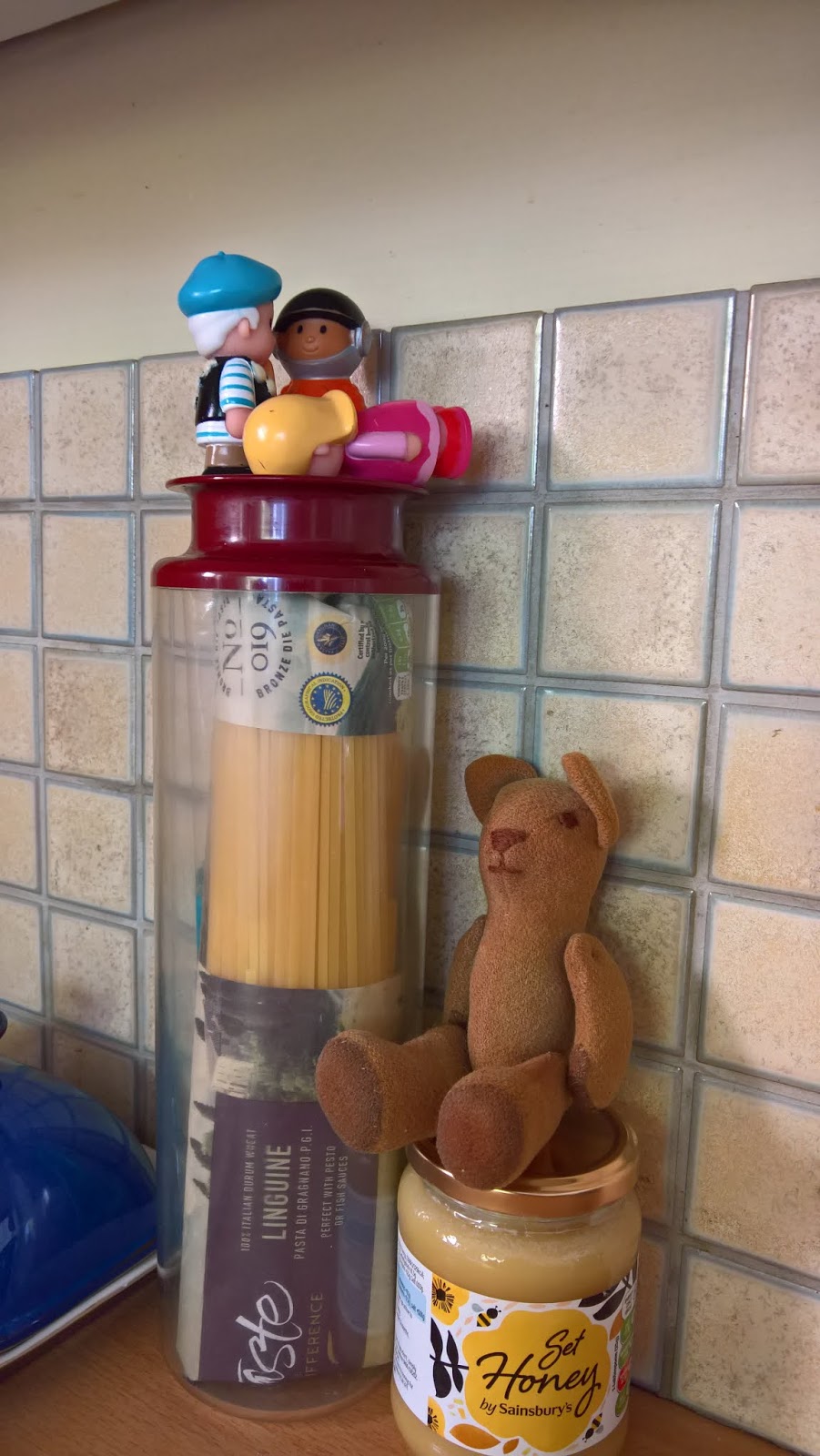
To this end, they investigated the spaghetti jar, left out next to the bread board for one reason or another. They got to the top alright but unfortunately Polly, despite having a good look through the keyhole in the lid, couldn't see how to get in.
While Baby Bear was having trouble with standing up, and had to sit this one out on top of the honey pot.
In the end they all had to settle for portions of left-over, baked custard with nutmeg on top. It's a bad business when you can't take charge of your own life, your own diet - even when it was the first custard baked at this address for many a year.
PS: honey ordinaire from Sainsbury's is a lot cheaper than the honey which is made in our very own road. Cute but dear - and packaging aside, I am not sure that I can tell the difference when used to sweeten hot lemon.
Reference 1: http://psmv4.blogspot.com/2020/04/when-we-were-young.html.
Group search key: wwwy.
Shadow Rock Farm
Simenon lived at a place called Shadow Rock Farm in Lakeville, Connecticut for five years or so after he married his second wife, say 1950-1955. This morning, I was moved to find out exactly where this might be.


Bing turned up reference 1, which claims to have run the farm down to 27 Cleveland Avenue and offers a couple of pictures, one perhaps from roughly the time that Simenon was in the area, one from a realtor of today.

Next stop gmaps which answers to this address, but does not offer Street View. With the snap above showing an aerial view of what is probably the right place, with the snaps above being taken from the south, from near the bottom of the aerial view.

The nearest that Street View gets is the junction of Farnum Road - left fork above - with Sharon Road, aka CT.41, just by the Mobil gas station. Farnum Road eventually leads to a junction with Cleveland Street. According to reference 4, the house looks to be worth less than $400,000, despite the seven bedrooms and twenty seven acres. So very cheap compared to a comparable house in the UK and probably not expensive for the US. So why did the Street View camera not bother with it - particularly considering the very remote places it does get to?
The story at reference 1 is confirmed by the rather longer story at reference 2, part of the large Simenon site starting at reference 3. Another ramification of the Simenon industry. I wonder who gets his royalties these days - with a lot of his stuff still being in copyright? With a quick peek suggesting that this might run for 70 years after the author's death, in this case 1989, taking us to 2059, by which time important chunks of the world might be under water.
I wonder also whether the municipal property records from the 1950's are still available to be inspected in the vicinity of Lakeville, which would be closer to proof positive. Here in the UK, I dare say, without checking, that one could dig up electoral rolls from that time, which would do the trick.

DPLA of reference 5, had nothing for 'shadow rock farm lakeville' and nothing for 'simenon lakeville', but it could manage the poster above for 'simenon', thought to be from 1957 Nashville. Among a small number of records about other simenons. An adaptation of a book which I read more than ten years ago now and noticed in a very cursory way at reference 6 and in a slightly less cursory way at reference 7. Before, again without checking, I got going on Maigret. Not sure about 'The snow was black' as a translation of 'La neige était sale', which I have always understood to mean that sort of dirty, messy grey that street snow often goes to at some point between white arrival and wet melting. Also that 'sale' has a rather unpleasant aura about it that 'black' does not. That said, I cannot presently think of a better translation.
Furthermore, I don't seem to have twigged back in 2008, that the town in question was probably mainly Simenon's home town of Liège. Which certainly runs to a big river - the Meuse - and some fairly steep looking hills. Time for another look.
Reference 1: https://findery.com/Chung123/notes/simenons-mystery-shadow-rock-farm-location-found.
Reference 2: http://www.simenon-simenon.com/2017/02/simenon-simenon-dream-house-for-novelist.html.
Reference 3: http://www.simenon-simenon.com/.
Reference 4: https://www.redfin.com/CT/Lakeville/27-Cleveland-St-06039/home/109715310.
Reference 5: https://dp.la/.
Reference 6: https://pumpkinstrokemarrow.blogspot.com/2011/11/double-georges.html.
Reference 7: https://pumpkinstrokemarrow.blogspot.com/2008/06/dt.html.
Subscribe to:
Posts (Atom)