Showing posts sorted by relevance for query box caterpillar. Sort by date Show all posts

Friday, 23 August 2019

Caterpillar control: episode 1

Following the report of a box tree caterpillar infestation at reference 1 and following the suggestion on the RHS site that control was difficult and the best thing to do might be to replace the bushes with something else, the three box bushes concerned have now been cut back to around a foot off the ground. Maybe I will leave the stumps to sprout and then see how things go - but it is more likely that I will grub them up, on the grounds that the infestation is likely to return in the absence of serious chemical action. A pictorial record of the cutting back follows. Followed by a few remarks about the caterpillars.

First of the three bushes coming down
Unfenced compost heap at this stage
First bush down
The bushes from which the wood blocks used by my wood cutting uncle must have been a good deal bigger than this, even allowing that large blocks were composites, made up of several smaller pieces. Made by cutting across the grain, not with the grain, so these branches would not have been much good at all. Maybe there is also a distinction between heart wood and sap wood which needs to be taken into account.

Second bush down
Trying to escape the cataclysm
Third bush down
Terminal compost heap
Maybe I should have had the waste incinerated to make sure all the caterpillars, pupae and eggs were destroyed, but I decided, on balance, that this was not the way forward. In part because plenty of caterpillars, pupae and eggs would escape any such incineration.

Oddly, the loss of these three bushes, perhaps eight feet high, has made surprisingly little visual impact. The area is shady, surrounded by copper beech, regular beech and other trees and bushes, and does not look that different now than it did before.

Oddly also, while the infestation seemed to spread from the ground up, with freshly layered bushes (the bushes seem to layer quite freely) all being infested, the various juveniles (only a few inches high) in the vicinity do not seem to have been infested.

Escaped
This morning, near 48 hours later, I found one of the caterpillars making a bid for freedom, climbing up the study window, presumably towards the light. It must have fallen off my clothes when I came in.

From the references which follow, I find that the caterpillars are a major pest in China, Korea and Japan where box topiary is big business. They arrived in Germany in 2005 or so and got to England three or four years later. There is some infestation of the bushes of Box Hill, but not of the much larger collections of bushes to be found in the Chilterns. Parts of continental Europe have been badly affected.

While the caterpillars - which may go through three or four life cycles in a year - will spread themselves, most of the spread is put down to movement of infected plants from nurseries.

The caterpillars have also reached southern Ontario, in Canada, so it seems likely that despite fierce vegetable quarantine rules at the US border, it is only a matter of time before they jump across.

For those interested in the taxonomy of these caterpillars (and the moths they metamorphose into), see references 4a and 4b. A fascinating subject in its own right, involving, inter alia, careful inspection of the genitalia of the moths. For which purpose dissecting equipment and a microscope are helpful. While I have yet to see a moth.

Reference 1: https://psmv4.blogspot.com/2019/08/box-tree-caterpillar.html.

Reference 2: https://www.ebts.org/box-moth-and-caterpillar. A helpful introduction to the subject.

Reference 3: https://en.wikipedia.org/wiki/Cydalima_perspectalis. Wikipedia is on the case.

Reference 4a: http://www.eje.cz/artkey/eje-201003-0012.php.

Reference 4b: Phylogeny and nomenclature of the box tree moth, Cydalima perspectalis (Walker, 1859) comb. n., which was recently introduced into Europe (Lepidoptera: Pyraloidea: Crambidae: Spilomelinae) - Richard Mally - 2010.

Saturday, 28 September 2019

Microsoft news

A Microsoft news item (via the Edge browser) caught my eye this morning on account of a striking picture from the Czech Republic of a specimen of the critically endangered sorbus rhodanthera.

This turned out to come from an open access report (reference 1) about endangered trees in Europe. While not from the European Union, the preface to this report is written in impenetrable Euro-speak, quite impenetrable enough to have Euro-haters frothing at the mouth. While the body of the report has lots of complicated maps and lots of handsome pictures of trees.

The first of these handsome pictures does not come from the Czech Republic at all, rather from our very own River Wey at Headley Park, was taken by one John Spooner and is available from something called Flickr, a something which I have heard of but know nothing about. It caught my eye because we have a Headley Heath near us, here at Epsom, but this Headley turns out to be near Bramshott, in Hampshire, just off the A3. Also the home to the River Wey Aqueduct of Bramshott Court, seemingly an important piece of early modern water engineering, helping along the watering of the meadows there, thus substantially increasing their value. Bing has not been terribly helpful on this occasion, so clearly all places to visit next time we are at a loose end, or need a comfort break, on this stretch of the A3.

Then following up our troubles with our box bushes, rather confusingly called buxus sempervirens or everlasting box, I thought to ask the report about box - with 11 of the twelve mentions being down to boxes in the text, rather than box trees in the ground, with the trees being classified as of least concern. Clearly not enough of the many authors of this report have heard of the box tree caterpillar. Report completely discredited.

I associated to the scene in an episode of Lewis (on DVD for once, rather than ITV3) in which university professors visit university libraries (in this case the Bodleian) in order to check that all their books are present and correct on their proper shelves.

But I have taken a copy of the report and it may get a second look at some point.

PS: I feel sure that we have walked in the woods at Bramshott Common, and taken pictures there, noticed in the first instance because Canadian troops were stationed there during the first and second world wars. Many of them died there, of the flu epidemic which came after the first. But I have yet to turn up the post.

Reference 1: European Red List of Trees - Malin Rivers, Emily Beech and others - 2019.

Reference 2: https://psmv4.blogspot.com/2019/08/box-tree-caterpillar.html.

Reference 3: https://psmv4.blogspot.com/2019/08/caterpillar-control-episode-1.html. There is also an episode 2.

Friday, 30 August 2019

Caterpillar control: episode 2

At the end of the last episode, I was wondering whether to leave the cut back box bushes to regenerate. But within a day or so I had decided that I should not leave them, being reasonably confident that the infection would return - from eggs, debris or whatever scattered about the place.

In little more than an hour with the mattock and spade all three stumps had been grubbed out.

The stumps
Final resting place
Final resting place by the fence, where they will serve to reinforce the aging split chestnut and also as a nature preserve for beetles, of the non-pest variety. The small box plant visible at the bottom of the snap seems perfectly healthy but is growing very slowly, having been there for more than a year now. Perhaps the lack of water and light is slowing things down - and resulting in what leaves there are being rather tough not tasting too good to the caterpillars.

As if they had never been
The next day it was as if they had never been. If you looked you could find where they had been, but that was about it. Note the yew stump left: to think that I had been pleased when I took the yew down a few years back, on the grounds that it gave back some space to the path adjacent and gave the box space to prosper. Which it did for a bit.

The new yew bushes
Off to Chessington Garden Centre with the plan being to buy some honeysuckle box, of which we already have a fair bit, making up our back hedge, where it seems to manage OK in the shade. With reference 2 offering a snap of one from the Common.

But the young man in the bush part of the Centre told us that box had been discontinued because of all the pests that have arrived over the past few years. Honeysuckle box had not been struck off the list, but he did not have any in stock, even in the rather expensive specimen tree section. Not did he have anything else of the same sort in stock. So we settled for a couple of yew bushes at near £10 a pop. Which I thought rather dear for a plant which is very easy to grow: but then, he had them in stock and I had not bothered to bring on any of the various suitable seedlings dotted around our garden myself.

Planted out in no time at all, as snapped above. Including most of a well rotted bag of stable manure, stirred into the top soil and delivered to us from time to time by a chap from somewhere on the western outskirts of London. I forget why he comes round here. Notice the handle of the trusty mattock right.

Wired up
Next worry was about whether the foxes would dig up the freshly dug, damp earth in a quest for earthworms, a food they are rather partial to. Luckily I was able to rustle up enough short poles and enough wire to wire them up, as snapped above. So far the foxes have left them alone.

A bit unsightly, but once the ground has settled down, perhaps in the spring, I can take the wire and posts out again.

Reference 1: http://psmv4.blogspot.com/2019/08/caterpillar-control-episode-1.html.

Reference 2: https://psmv3.blogspot.com/2017/01/honeysuckle-box.html.

Saturday, 17 August 2019

Box tree caterpillar

Underneath the oak and beech at the bottom of our garden there are a number of box bushes, bushes which are now maybe twenty five years old, around eight feet high and more or less never pruned. Rather handsome, though I say it myself.

Unfortunately, last year they started looking a bit sickly and now they look very sickly, with the lower branches of most of the bushes being badly affected and largely defoliated.

After a quick look at the RHS site, I thought box blight, a fairly serious fungal pest, but then closer inspection of the bushes revealed some colourful green caterpillars, rather more than an inch long. Almost certainly the box tree caterpillar, a pest which has arrived in Europe - or more particularly around London - in the last ten years or so. A native of east Asia.

Presently wondering what to do. Not keen on sprays as the word seems to be that one needs a lot of it to get through all the webbing spun by the caterpillars. And most of these sprays contain all kinds of bad things, noxious to oneself as well as to caterpillars. Maybe the bushes will just have to go.

This snap turned up by Bing, with the caterpillars marked by the yellow cartouches, shows a bush in rather better condition than the lower reaches of ours.

There is a snap of a handsome moth at reference 1, but I have not seen one myself.

Reference 1: https://www.lovethegarden.com/uk-en/article/box-tree-caterpillar.

Saturday, 25 April 2020

Bug box

Our bug box had been attached to a post near the garden bench near the three ponds for some years, not attracting that many bugs. Perhaps because there was too much human activity in the vicinity, perhaps because there was too much sun.

So a couple of days ago, I thought to move it further down the garden to a quieter, shadier spot, where, perhaps, it will attract a bit more bug action. Maybe we will learn what sort of bugs are attracted to nesting boxes of this sort.

Now fixed up with a new brass screw, which slots into the back of the box, and I thought it best to take the old steel screw out of the post near the bench. It being possible if not that likely that one could catch something on it. Screwdriver failed to move it, but I then remembered about using Stillsons and Footprints for moving dead screws. I settled for my medium sized Footprint, nearer to hand than the Stillsons, and it did the business, albeit fatally for the head of the screw.

Note remnants of box bush, bottom left, cut down in the wake of last year's plague of box tree caterpillars, also from the far east, where I believe it is a major pest in South Korea, where they are as fond of box bushes as we are. See, for example, references 1 and 2.

Note also remnants of the chicken wire attached to the top of my split chestnut fencing, intended by a former neighbour to keep his wife's dog out of our garden. With split chestnut fencing, which I am otherwise rather keen on in the wilder setting, not serving the purpose. Doesn't stop the movement of foxes either, who if they can't get through, can certainly get over.

Reference 1: https://psmv4.blogspot.com/2019/08/caterpillar-control-episode-1.html.

Reference 2: https://psmv4.blogspot.com/2019/08/caterpillar-control-episode-2.html.

Sunday, 24 November 2019

Grotto

Monday past to Polesden Lacey to get an early sighting of their Christmas decorations. Boned up a bit beforehand by reading Osbert Sitwell on the subject, he being a regular guest of Mrs. Greville's at Poleseden Lacey and elsewhere for most of the inter-war years. A convenient appendage for a lively widow?

Winter lights
Dull first thing, but bright enough by the time we got to Polesden at around 1100. To find the latest thing in portable lighting erected in the car park to this heritage attraction. Perhaps it would be more in the spirit of things to have trusty's wandering around in the dark, dressed up in dark cloaks and so forth and carrying large lanterns?

Winter sheds
Garnish
No Christmas operation can be said to be complete these days unless it includes a Christmas market, so some sheds had been wheeled in for the purpose, probably stocked from some even bigger shed somewhere in North Kent (estuary land). I was interested to see that the market business is now organised enough that there are special sheds for the purpose, complete with fork-lift truck friendly undercarriage. Makes getting them off the low loader so much easier. With a bit of garnish to the sheds being provided by a yellow camper van, last seen at Hobbledown. Or at least one very like it. See reference 1.

First stop the cafeteria, a large part of which was laid out for Christmas Lunch for the trusty's. Of which we learned there were around 800, 100 or so of whom were outdoor, presumably necessitating a substantial personnel operation, staffed with salaried staff. Can't expect volunteers to do that sort of thing. But with 800 of them, they must be running their Christmas Lunches for a fortnight or so.

The power is coming!
Just past the camper van, there were two busy men in a hole, doing something electrical. Presumably providing power for all the sheds. Power which was being led in from the main house by a substantial trench along the edge of one of the lawns. Part of the price we pay for going early, before everything is shipshape and Bristol fashion.

Grotto tableau one
Into the house to find that the interior had been transformed into a Christmas Grotto, not that far removed from the large Grotto operation at Chessington Garden Centre, for which see reference 2. As is now the custom, the trusty's were dressed up in the fashion of Mrs. Greville's hey-day - and they had done their homework, well up for discourse on the various treasures and attractions of the house. Two of which have already been noticed under the group search key of pla - in which connection I had worried about search for 'pla' finding the many words which so start, like 'place'. Fortunately, I find this morning that blog search at least does whole word searching, so we don't get all the places and playgrounds.

Piety
Play
Along the way we took in some of the paintings. A rather mixed bag, but there were some that were very old (piety above) and some which amused (play above). We also took in some of the interesting china - perhaps porcelain? - but in the dark, grotto lighting, not so easy to see.

Caterpillar attack
Out to take a turn in the gardens, where we were pleased to find that they were doing their bit for the box tree caterpillar war. For which, for example, see reference 3.

Mushrooms
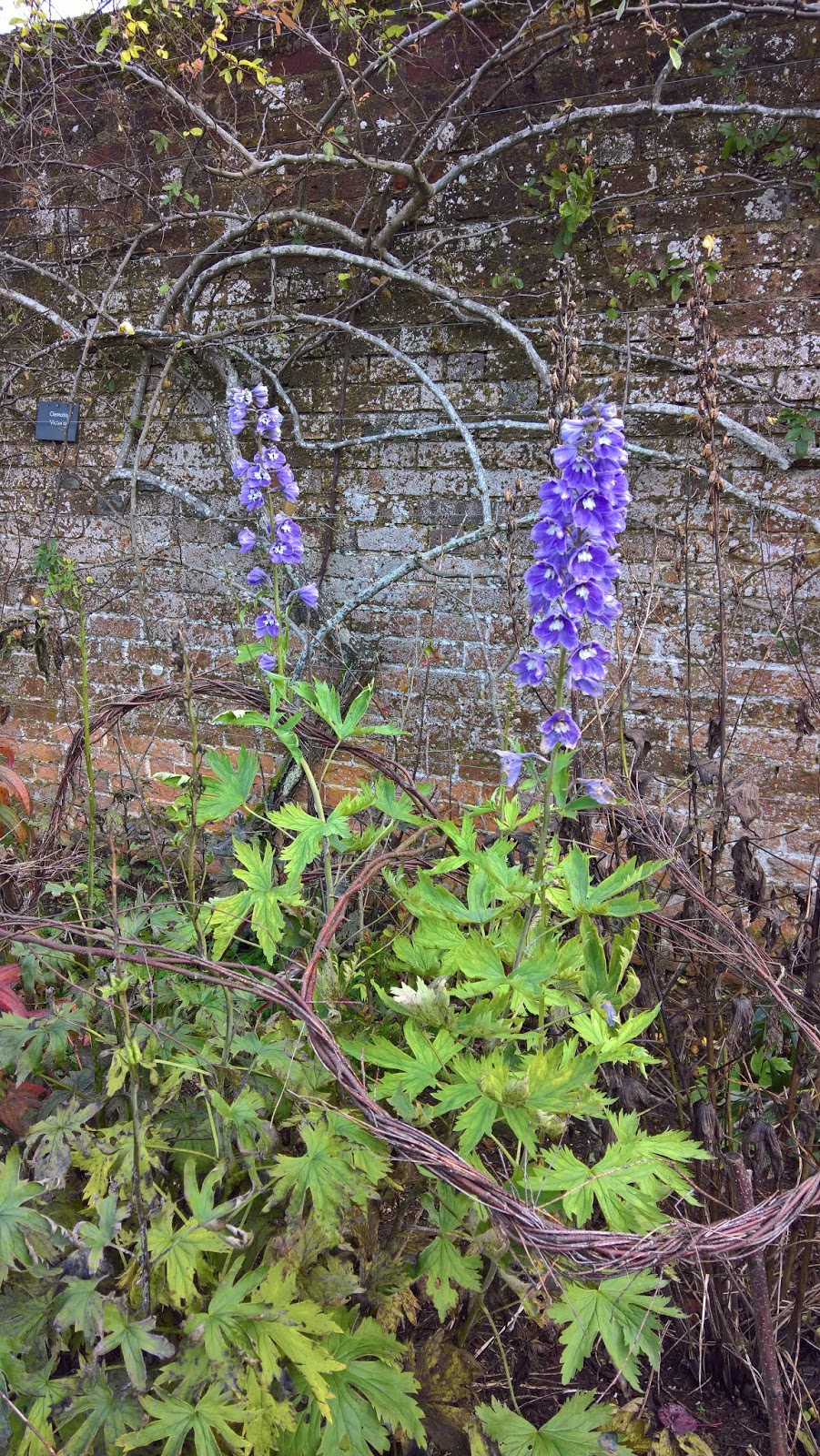
Late delphiniums
One of the rose beds did not have much in the way of roses - there were still some out - but it did have a good crop of mushrooms. Maybe they come in with the organic compost, possibly from one of the tenant farms around the estate. We also had some late delphiniums, flowers which I rather like but which I have never attempted to grow.

The cafeteria looked rather busy with the trusty's having their lunch, so BH elected to go the back way to the Stepping Stones public house, just by Box Hill & Westhumble railway station, underneath Box Hill. With Westhumble being rather an odd, strung out sort of place, with all kinds of odd buildings. See reference 4 for a taster. We were unlucky enough to meet a dustcart on the way, a smaller dustcart which was well suited the smaller road, but lucky enough that the driver reversed into a handy driveway, rather than sitting and waiting while I tried out my rather rusty reversing skills.

The Stepping Stones public house was possibly repurposed from something else (there was a rather odd, semi-detached chimney round the back) to work the Box Hill day tripping trade when the railway came to town and was probably substantially extended in the more recent past. But all that apart, we were greeted by a very cheerful and efficient barmaid, a lady of middle years.

Artefact?
Settled for pie and veg. The pie was average, almost certainly from a factory rather than made on the spot ('home made' in the jargon of the casual dining trade) and the vegetables were very good, unusually so for said casual dining. I think they even involved a spot of lightly boiled green cabbage. Once again, I forgot to ask for the gravy to be supplied in a jug, so I had rather more of that than I wanted. But, overall, very good. We may be back.

We had also wondered about the artefact snapped above. Was it some cult object from equatorial Africa? Was it a piece of our industrial heritage? We decided on the latter, with it being turned by means of the wooden gears of a water wheel, with belts driving machines of some sort being slipped over the two ends.

Threatening sky
Onto Ashtead to pick up the Guardian and bread rolls noticed at reference 5. Much banter along the way, no doubt fuelled by the wine from the Stepping Stones. Rather threatening sky over the M&S food hall, as seen from the car park. A food hall which is more like a shed from this side than it is from the front, where it is more faux old-style high street.

Major pot hole under the West Street railway bridge, a pot hole I would not care to have hit on a bicycle.

Mrs. Greville
Home to read our National Trust book about Mrs. Greville, to find that our copy, bought second hand from somewhere or other, had been signed by the author, one Siân Evans, a Welsh lady who specialises in this sort of thing. Unlike our Sitwell volumes, which no-one has signed. I was reminded that this beer heiress from Scotland made it her business to cultivate the royals, for which she clearly had both the money and the verve. To the point where the house was at one point destined to become the property of a royal younger son, perhaps the Lord Andrew of his day. A destiny which was not fulfilled as the house fell into the hands of the National Trust instead.

Reference 1: http://psmv4.blogspot.com/2019/08/hobbledown.html.

Reference 2: https://psmv4.blogspot.com/2018/12/christmas-grotto.html.

Reference 3: https://psmv4.blogspot.com/2019/08/caterpillar-control-episode-1.html.

Reference 4: https://en.wikipedia.org/wiki/Westhumble.

Reference 5: https://psmv4.blogspot.com/2019/11/oral-porn.html.


Group search key: pla.

Friday, 30 April 2021

Swinging the mattock

Getting on for a couple of years ago I took the stump snap above, in the course of clearing up after the ravages of the box tree caterpillar, last noticed at reference 2. Although the real point of the snap was to show the empty space where the box trees had been, before two young yew bushes were planted to replace them.

The stump left, as it happens, was the stump of another yew, taken down many years previously to give the then neighbouring box trees a bit more light. I kicked it from time to time, but hitherto it had always seemed pretty solid. However, yesterday, in the course of walking my bricks, I thought that it wasn't. So out with the demolition mattock and about twenty swings later the stump was out. Swelling out to a bit of a ball just below ground level, but seemingly without a serious tap root in the way of some trees - this despite probably being a natural seedling rather than some nursery raised confection.

With the mattock at the bottom of the snap above (from Bing out of eBay) being very much the sort of thing in question. But the point of interest is how twenty serious swings of such a thing does not seem to involve a lot of movement, but leaves one puffing a bit, as if one had just climbed up a reasonably serious hill. One must be using a lot more muscles than one realises.

And in my case anyway, the days are long gone when I could swing such a thing for hours at a time. Twenty swings is about my limit.

PS: pleased that I was able to recover the snap above, from archive, in about five minutes. System works!

Reference 1: https://psmv4.blogspot.com/2019/08/caterpillar-control-episode-2.html. The clearing up.

Reference 2: https://psmv4.blogspot.com/2021/04/posh-cabbage-patch.html. The last notice.

Thursday, 30 July 2020

A watering event

Fatsia of Wikipedia

The brick compost bin is near full, with all the autumn leaves to come. So emptying during the autumn is clearly indicated, with the idea being to bank it up behind the fence behind the new daffodil bed, perhaps providing some nutrients for the under-performing now-not-so-new bed. A fence which started out as a now elderly picket fence, but which, earlier this year, was reinforced with the steel mesh panels originally bought to stop small people falling into our small ponds. The idea is that, the (new small) box bush plan having been defeated by the combination of drought and caterpillar, ivy will grow up both pickets and steel, holding the whole lot together.

The compost bin is under trees and it takes a lot of rain for it to get really wet. So I thought it might speed up rotting down if I added some water to the mix. To which end I varied the up-legs of this morning's brick walk to give the compost 20 gallons. Hopefully a reasonable contribution to the rotting down of what might be as much as a cubic metre of mostly green garden waste.

Plus two gallons on each of the new yew bushes, planted to replace the (old large) box chopped down last year. See, for example, reference 4.

Plus two gallons on the spotted laurel, not doing too well underneath the ash tree, despite its robust performance in planters outside public houses.

Plus two gallons on the fatsia next to the spotted laurel. Not doing very well this year at all. Not nearly as well as the offering from Wikipedia at reference 5.

One gallon for every brick.

Not the kind of watering I usually go in for. The idea being that plants in the my part of the garden have to manage without that kind of attention, which most of them, to be fair, do.


Friday, 20 September 2019

Horton Clockwise

A few years ago, the Horton Clockwise was my morning walk of choice: north up Horton Lane then cut across to Longmead Road and south home. Last week, I thought to reprise on the bicycle, making a serious attempt to use the various cycle paths provided.

Honeysuckle box
More than two years since I last snapped this one. Different light, a bit more fluffy perhaps not quite as healthy, but otherwise much the same. Not, as far as I know, prone to the ailments which afflict the ordinary box. See references 1 and 2.

Next stop, the allotments at the northwest corner of the Christchurch Road junction with Horton Lane, first noticed four years ago at reference 3.

Inner deer fence
The substantial gate through the insubstantial deer fence (recommended, I learned, by the eco people attached to Horton Country Park, people who ought to know) was open so I was able to park up and talk a walk inside. The gardens were mostly let and coming on well, with plenty of evidence of private enterprise in the matter of deer fences.

Outer deer fence
Flowers as well as vegetables, with the outer deer fence visible behind. Black plastic netting on 4 inch diameter posts, perhaps 6 feet high, perhaps 10 feet centres. Probably deer proof but not child proof - but that does not seen to be a problem yet.

Dahlias one
Dahlias two
Chapel under wraps
A little later, coming up to Horton Retail, I thought to take a look at the Chapel there, once the chapel for part of the (mental) hospital cluster, which seems to have fallen off this year's heritage open day listings. The reason turning out to be straightforward enough: being refreshed. Too good for the local Muslims, but just right for a community theatre action group, possible the people at reference 4, otherwise reference 6, this despite the fact that the borough already has at least two theatres. That said, not clear that the Muslims would have been able to raise the sort of money now being spent on the place, at least not without a bit of help from heritage and other central funds.

It so happened that the chap in charge was not that busy at the time, so he was able to show me around. A chap who had a stake in the place as his mother had once been a nurse in Manor Park Hospital and had taken mass in the chapel on a regular basis, it, quite properly for such a place, being interdenominational. We talked a bit about the fate of all the people who would, in the olden days found asylum (people with serious mental disorders) or incarceration (unmarried mothers who got even more unlucky) there.

The chapel looked to have been well built in its day and would be a handsome space when the refurbishment was complete. The sash windows looked to be in pretty good condition for their hundred years or more. The standard of workmanship and detailing was good - far too expensive for a building today. The parquet floor would clean up. And, unlike at Clandon of reference 5, the fake classical pillars contained bricks rather than empty space - bricks which had been cut to the circular shape.

One of the expensive bits was going to be taking the handsome barrel vaulted roof off and rebuilding it to modern standards - presumably including heat insulation - which must have been a problem in the good old days.

It will be interesting to go back in a year's time and see how it has all turned out.

And so, via Longmead Road, back to Costcutter to find that they still had 5 Guardians left, despite it approaching midday. Perhaps they have upped their order by one or two.

Reference 1: https://psmv3.blogspot.com/2017/05/honeysuckle-box.html.

Reference 2: https://psmv4.blogspot.com/2019/08/caterpillar-control-episode-1.html.

Reference 3: https://psmv2.blogspot.com/2015/08/long-grove-park.html.

Reference 4: https://mgso4festival.org/.

Reference 5: https://psmv3.blogspot.com/2018/06/more-clandon.html.

Reference 6: https://hortonchapelproject.org/.

Sunday, 26 January 2020

Winter garden

A week ago to see the winter garden at Polesden Lacey, to correct the rather not very satisfactory taste left by the Christmas Grotto, noticed at reference 1. Clearly a busy day as I found time to secure warfarin supplies (before Brexit) and to capture two trolleys before the off - with the second being noticed at reference 2.

The gatehouse
First thought was at the gatehouse, snapped above by the Google Street View people. Great ugly thing, serving no apparent purpose other than marking the boundary and providing a frame off which to hang the gates, presumably rarely used as the place is open getting on for every day of the year. Just Christmas Day excepted? Just think of all those hundreds of pensioner volunteers with nothing better to do. All 800 of them according to reference 1.

Was it a job creation scheme put on by a kindly landowner during the depressed years between the wars? Did the gatehouse once contain little guard rooms where the gatekeepers logged comings and goings in some huge leather bound ledger? And who gets to live in the accompanying lodge right?

The main car park was nearly full at 1115 and it was clearly time to open the overflow car park in the field next door. And we learned later that the both car parks filled up the next day, Sunday, and that people were being turned away. People who might have driven a long way to visit the winter gardens, the shop - or perhaps just to walk their dog.

Lots of all kinds of people to go with the cars. Quite a lot of people in wheel chairs. Quite a lot of small children. At least one party of people from what sounded like the US. Perhaps from the nearby school for same. Apparently one of a small family of such schools, with the website being a little coy about the US connection. Even about what 'ACS' stands for - with my guess being American Community School - a usage not to be found among the near 200 suggestions offered by Bing. A usage which always irritates my Canadian relations, who think of themselves as Americans too. See reference 3.

Hellebores at entrance
Box?
Box like edging to a rose bed. Looking very healthy, with no caterpillar or other damage, and not quite like regular box.

Winter aconites one
Winter aconites two
The star turn in the winter garden was a display of winter aconites, far more flashy than the display you get in the wild part of Hampton Court Palace gardens. Not fully out, but doing pretty well. Plus a sprinkling of snowdrops and cyclamen. These last in foliage rather than flower mode.

Escaped from the Isle of Wight
Some modest echiums, a grand display of which is to be found at Ventnor Botanic Gardens, the place which used to be a TB sanatorium when TB was rampant - a disease which is very visible in the early Maigret stories, written in the 1930's. Last noticed at reference 4.

Start of the yew walk, looking back towards the house
A bit further on
Root. In memoriam, Monica Poole
Headed east into the trees, then back along the yew walk, running above the formal hedge overlooking the downland. With the formal walk which goes with it - to the left in the first snap above - probably rather the worse for wear and winter. Probably closed. Plenty of yew trees and bushes, nothing quite on the scale of those at Newlands Corner, noticed in August last year.

Big trees
Trunk one
Trunk two
Trunk three
Base
Leaves, for the avoidance of doubt
Scar
Big trees looked well in the bright morning light. Scar left by trenching in the power for the Christmas sheds not so well. See reference 1.

Promise of daffodils to come
Sturdy lights
Lights had been strung up all over the place to service the grotto. Looked like fairly serious stuff and must have cost a fortune. Which I might not like, but apparently the takings in the shop during grotto time were double what they had been the corresponding period last year, despite some moaning about the poor quality of the sheds. And takings in the shop are no doubt what matters to the senior management team, or whatever such people are called in National Trust speak.

Decided against both elevenses and lunch on this occasion, choosing to head home instead, with our car park slot being snapped up as we left it.

Came across a new to us Infiniti car on the way home. Bing tells me that this is a luxury brand from Nissan which has been discontinued in this country. With the car executive now holed up in the Lebanon having had ideas about jumping onto the eco-band-waggon and going electric. Which this one certainly was not, having two large exhaust pipes peeping out. Not much to be gleaned from reference 5. Reference 6 rather better. Both quite keen on arty shots of mountains and forests.

And then there was a large pot hole under the West Street bridge. One of the lowest spots in Epsom, so perhaps the heavy rain had got to it, despite the soakaway into the chalk under.

And amused after we got home, to read in the DT that it was not very clever to keep more than perhaps 10% of your money in the UK. Better pickings elsewhere. And this from the newspaper which trumpets the glory of Brexit with Boris. The newspaper which, according to a rather sour piece in the current NTRB, once used to pride itself on the accuracy of its reporting. Journalists guilty of error up before the editor for wigging or worse.

Reference 1: https://psmv4.blogspot.com/2019/11/grotto.html.

Reference 2: https://psmv4.blogspot.com/2020/01/trolley-368.html.

Reference 3: https://www.acs-schools.com/#1.

Reference 4: https://psmv4.blogspot.com/2019/06/the-big-tomb.html.

Reference 5: https://www.infiniti.co.uk/.

Reference 6: https://www.infiniti.com/.