Tuesday, 21 April 2020

Pivot update

At reference 1, I reported difficulties with including rows for which there was no data in a (Microsoft Excel) pivot table, the rows in questions being days or dates.

Today, I had another go. First, I included an additional row for the date in question, March 30th, with shift scored as minus 1. This resulted in a zero row for that day in the pivot table. But a little clumsy, using two rows in place of none. Second, I included an extra column called 'records', which always took the value 1. Then for March 30th all the data columns were set to zero. Again, this resulted in a zero row for that day in the pivot table, as shown in the snap top left. And using two rows in place of none seems better than using two.

All this arises because of Microsoft's concern to make the production of tables as easy as possible. The user has to do little more than nominate the rows and columns. Specialist tabulators, in which I once took a professional interest, put rather more work on their users, requiring them to specify the various dimensions of a cross tabulation as entities in their own right, rather than their being by-products of analysing the data. An approach which, as well as side-stepping the zero row problem, allows the inclusion of a profusion of sub-totals, should that be desired, as it often is when, for example, the dimension corresponds to a data item which can take many values, such as area or cause of death. And some of the better tabulators can even have a stab at data items which can make several values for just one record - which would enable, in our present difficulties, useful work to be done with multiple causes of death.

To be fair to Microsoft, they do have a stab at sub-totals. They know that date is a date field, from which month can be extracted, so they offer monthly sub-total, which one gets by ticking the months box in the large panel, top right in the snap above.

Reference 1: https://psmv4.blogspot.com/2020/04/pivoting-bricks.html.

Monday, 20 April 2020

Tweet

What must be our local kite flew across our garden, from left to right, heading north, not much higher than chimney height, at 0637 local time this (Tuesday) morning. Close enough to reveal a pale but mottled underside (ventral).

Last noticed, getting on for a couple of weeks ago, at reference 1. On the other side of the road.

Reference 1: https://psmv4.blogspot.com/2020/04/tweet.html.

Series 1, Episode V

Today Grandma warmed up the left over cheese sauce, mentioned yesterday, to go with the left over boiled bacon and a further round of boiled vegetables. Nearly all of it went for lunch and without thinking she left what there was left next to the toaster in the kitchen and went back to her dessert next door. A dessert involving orange jelly and white yoghurt.

Then while Grandma was next door, Poly, Pedro and Yuri thought it would be good fun to climb into the bowl and have a warm sauce fight.

Sadly, all good things come to an end and when Grandma came back into the kitchen and caught them at it, they were all sent outside to have a cold bath in the water butt, filled by yesterday's rain.

Reference 1: https://psmv4.blogspot.com/2020/04/series-i-episode-iv.html.

Group search key: wwwy.

Fraxinus

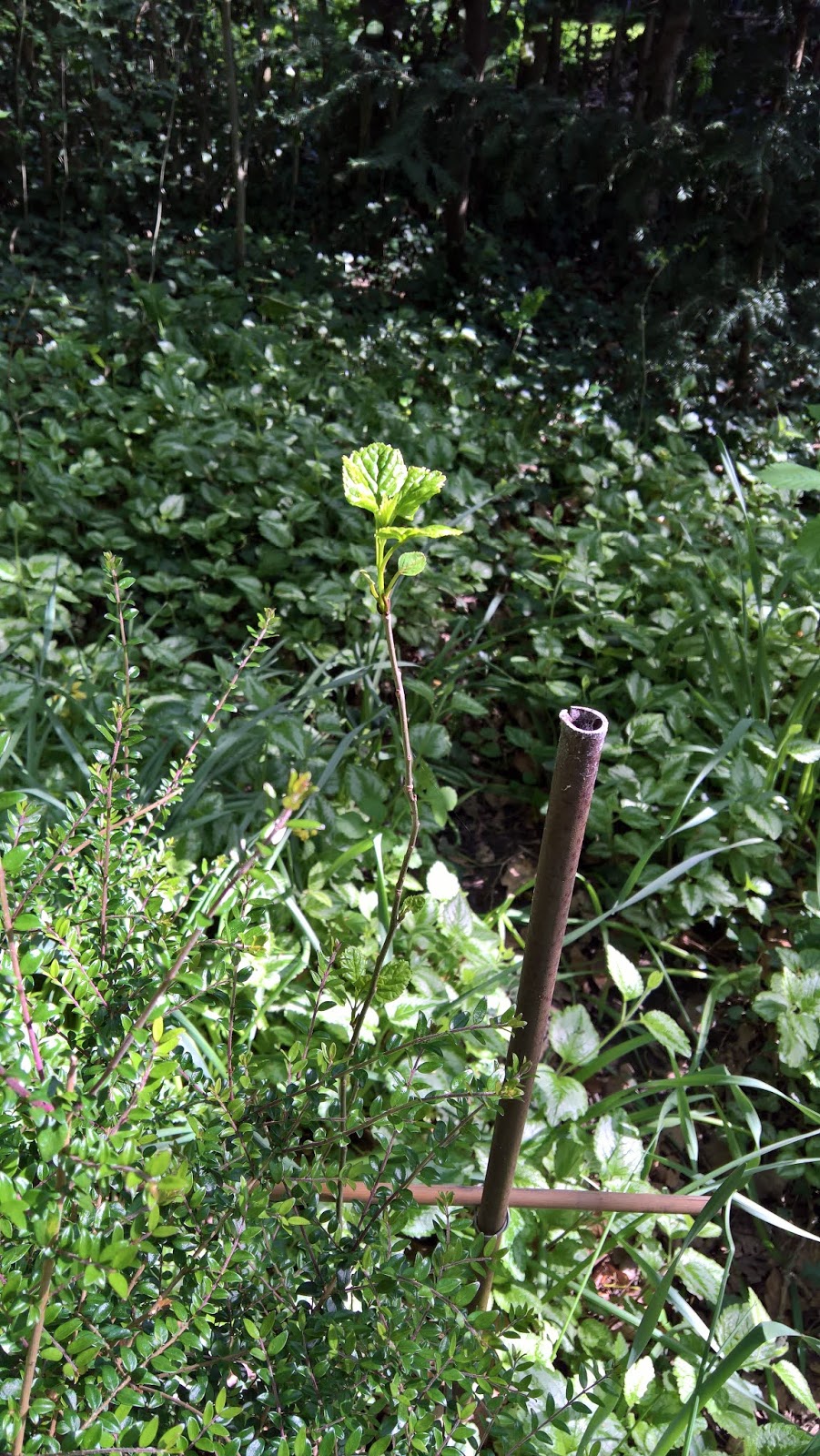
About five years ago a chap from the RHS identified a seedling on the edge of our back hedge as a fraxinus excelsior f. diversifolia. This was noticed at reference 1. Later that year, I cut it down by accident, but was pleased to be able to report the following year at reference 2 that it had sprouted from the stump.

However, while it is still there, and now carefully protected, it has never really recovered, and has yet to make the size it had back in 2015. As can be seen in the snap left, with the lead bud not long burst. There are some more buds further down.

Maybe, by the end of this year, it will have attained its former size.

Meanwhile, some confusion on the taxonomy front. What does the 'f.' bit in the name do? Why are the leaves at reference 3 pointed, rather than the round of my seedling? Is it one of those trees on which the shape of the leaves depends on circumstances; the amount of light, the age of the tree and so on. It is certainly the case that ivy leaves vary considerably in size and shape from place to place, from plant to plant.

Reference 1: https://psmv3.blogspot.com/2016/06/fraxinus-excelsior.html.

Reference 2: http://psmv2.blogspot.com/2015/07/not-exotic.html.

Reference 3: https://www.vdberk.co.uk/trees/fraxinus-excelsior-diversifolia/.

Philosophy

My understanding is that philosophers have spent a lot of time over the centuries - not to say the millennia - worrying about whether things would really exist if we were not around to look at them. With my understanding quite possibly being very wide of the mark, as I find the whole subject rather difficult and so never give it much time.

Not even convinced that there is much point given the present state of knowledge about the world. Although I grant that it might have been different for Plato, who had a big brain - but not a lot of data to connect it to.

Notwithstanding, for some reason, it sprang into my mind yesterday that in so far as colour was concerned the answer to the question was a clear 'no'.

The way we perceive colour clearly depends our having complicated eyes wired into complicated brains. The colour 'red' has no existence outside of human brains, excepting possible those lower animals which still have decent eyes and brains of a sort.

It may well be that objects which we see as red reflect or absorb the light hitting them in different way to object that, for example, we see as blue, but that is not the same thing at all.

Properties like size or temperature are a bit different, as while the senses help, we can't sense either size or temperature in the fine grained way that we sense colour - and for that we need instruments.

While a property like surface texture is different again, with different surfaces feeling very different to the fingers, but with instruments capable of doing the same job having only recently become available.

So roughly speaking, the objects might exist whether we are there or not - but the properties, the subjective experiences, through which we know of them, know about them do not. We know about how the objects interact with us, not about what they are. And as anthropologists (and probably psychiatrists) know all too well, you change what you interact with.

Clearly a topic to mull over during the morning's brick shift to come. In the intervals of thinking about whether it should be rows, stacks or what.

Sunday, 19 April 2020

Fights back

We had been wondering about how Terroirs of references 1 and 2 had been faring in lockdown world.

With our last visit (reference 1) having been, inter alia, the occasion of the drunken whale which got misplaced, a misunderstanding which we did not get around to resolving in time, and which is now likely to have to sit in the pending tray for quite some weeks yet.

Nostalgia for their long lunches, enlivened by the odd drop of this or that, will grow. How long will it take to put things back together again when life is allowed to return to normal? Will we take to taking our lunches outside, where the air is fresher and we can keep and eye on the comings and goings of the police, rather than on the comings and goings of the young staff and the generally older customers? Not altogether clear that what one sees from Terroirs is the (Charing Cross) police station, as the entrance is actually around the corner in Agar Street - but they clearly find it convenient to park their big white vans in William IV Street.

Meanwhile, Terroirs appears to be fighting back and is offering a home delivery service, yet to be investigated, as per the snap above.

Reference 1: https://psmv4.blogspot.com/2020/02/courtauld-first-campaign.html.

Reference 2: https://www.terroirswinebar.com/home.

Series I, Episode IV


Polly was a getting to be a bit put out that she was not getting into Grandpa's brick scene. So this morning, she persuaded Yuri and Pedro to join her in an assault on the noon-tide brick heap.

So, while Grandpa was messing about in the kitchen with his cordon rouge cheese sauce, involving both onion and celery, fried in a little butter, to go with Grandma's special boiled bacon and boiled vegetables, they would sneak out of the front door while Grandma was peeping down the side passage to see if any packages had been left there overnight.


Nip round the back, collect digging sticks from the tub where they live - and off up the brick heap. It was quite scary as the bricks, being both old and varied, were quite wobbly. There might even be an avalanche. On the other hand, there were plenty of cracks into which they could push their digging sticks to make footholds, as can be seen in the close-up above.

As was only fair, Polly was at point and summited first. To be followed by Pedro and then Yuri, backstop on this occasion.

The only bad thing was they had forgotten to bring the rope, so instead of abseiling down, which would have been fun, they had to climb down. Which was, rather to their surprise, quite a lot harder than climbing up. Which all goes to explain why cats (and toys) get stuck up trees so often.

Baby Bear was the lookout and he had been told to screech if he saw or heard any sign of Grandpa. And to screech especially loudly if Grandpa had a red face or was breathing heavily as these were bad signs, often of bad temper. He might even do a number and have a melt down.

Reference 1: http://psmv4.blogspot.com/2020/04/series-1-episode-iii.html.

Group search key: wwwy.