Wednesday, 4 August 2021

Back to the Blen

We returned to the Blenheim in the week after we returned to the big island. There had been media stories about Greene King having to close a number of their houses, mainly because of the pingpedemic, so I thought a scouting visit the day before was appropriate. The young lady whom I asked seemed rather puzzled as to why I was asking if they were likely to be serving lunch the following day. Would I like lunch now, to be going one with? This at around 17:00 in the afternoon. I declined this offer, but did think it polite to take a couple of glasses of Yellowtail while I took in the scene.

Only one slumberer, awake when I arrived but head down by the time I left. But not a problem: there were still vacant tables for customers who were still paying.

Back the next day, when BH found a suitable veggie salad and I found a suitable burger on the menu. BH very happy with her salad, and while my burger was satisfactory, having declined cheese sauce and not touched the gravy(!) on the side, I thought that next time I would go for the full DIY specification, available on the last page of the menu. One patty, medium rather than the well cooked of this occasion, two buns rather than one and go easy on the trimmings. Essentially meat ball sandwiches.

The red bag right has served for many years now, having started out as a remnant of a skirt length of Welsh tweed. Skirt long gone. Inter alia, the bag once served to hold cigar case, cigars, matches and cutter. All the paraphrenalia. On this occasion, sun glasses, sun hat, and telephone.

For dessert, a sundae: all cream, chocolate and sugar, but with two spoons it went down well enough. First time I have had such a thing for years. Thinking of the rock hard, complicated, ice cream desserts Indian restaurants used to serve direct from their freezers, we wondered whether the sundae had arrived partially assembled and frozen, then thawed in the microwave and finished off, but the waiter assured us that it had been assembled from scratch, on the spot.

Over the concluding Jameson, I explained to BH that if I were ever to be diagnosed with something like Parkinson's, I thought that I would take up cigars again. I am fairly sure I would still enjoy them. Fairly sure I would enjoy one after a meal now, but it seems a pity to run the risk of getting addicted again. Just one from time to time doesn't seem to stick and the downward spiral kicks in all too soon. Which is not where I want to be just presently.

We had taken lunch in the tent, out of the sun, which worked fine. Not much flapping at all. And there was a reasonable lunch time trade scattered about the place.

For some reason, I thought it necessary to take a photograph of the Araucaria araucana at the top of our road.

While this snap, from Thompson & Morgan, with its regular rows of leaves, demonstrates that there is some regular order about the densely packed leaves, described as spiral at reference 2. Maybe that means that the bases of the leaves form a helix. One day I will get to dissect a branch and find out what is really happening.

And I presume that the range being given as the southern and western fringes of the USA means that it is not very hardy, not able to stand the hard frosts of the interior and the north. The sort of frost that we get, OK.

It seems that the study of the arrangement of leaves is properly known as phyllotaxis, and the Wikipedia article offers the picture above of a repeating spiral. We are told that it all depends on the angle between successive leaves on the helix, for these purposes measured as a vulgar fraction of 1 - in which 'the numerator and denominator normally consist of a Fibonacci number and its second successor'.

PS 1: the serious reader may care to consult reference 4, which appears to join up the dots between the goings on at the level of cells and the spirals that can be seen above. The word 'phyllotaxis' is used a lot and 'Fibonacci' just once - but it is all too strong for me.

PS 2: the Royal Society seemed to want to charge for access, but a bit of poking around and one gets to reference 4b where access is free. All very mysterious.

Reference 1: https://psmv4.blogspot.com/2021/06/pub-glut.html. Our last visit, a bit more than a month previous.

Reference 2: http://hort.ufl.edu/database/documents/pdf/tree_fact_sheets/araaraa.pdf.

Reference 3: https://en.wikipedia.org/wiki/Phyllotaxis.

Reference 4a: The shoot apical meristem: the dynamics of a stable structure - Jan Traas and Teva Vernoux - 2002.

Reference 4b: https://www.ncbi.nlm.nih.gov/pmc/articles/PMC1692983/pdf/12079669.pdf.

Tuesday, 3 August 2021

Madame Liang

Following notice at reference 2, I have now got around to reading reference 1. A bit of a change after three months of Clarissa. An interesting change, an easy read story, but in rather dead prose which reminded me of that by Agatha Christie. 

This rather battered copy once the property of the library of St. Thomas' Hospital.

Born at the end of the nineteenth century into a missionary background, Pearl Buck spent most of the first half of life, forty years or so, in China. That is to say during the first waves of revolution which eventually resulted in the Communist takeover, years after she had left. The second half in the US where she produced over 40 novels and 20 works of non-fiction, nearly all about China, past and what was then present. This included backing some good causes and some bad ones. She ended up in the grip of a greedy younger man. I was reminded of Ayn Rand, first noticed at reference 5. With whom Buck presumably shared nicotine, as she died of lung cancer, but Wikipedia does not mention alcohol.

Various thoughts follow.

Buck makes a lot of the racial pride of the Han Chinese, a pride partly based on their long, more or less continuous history, a good bit longer than our own here in England. She hints at the corruption in high places - corruption which the Cultural Revolution was, in part at least, an attempt to root out. She also writes of the attempts, during great leaps forward, to substitute enthusiasm for expertise - attempts which addressed problems addressed in a different way during the early part of Soviet rule in what is once again Russia.

She also makes a lot of their love of fine cooking - which enable the titular Madame Liang to make a good living in Mao's China, only falling at the time of the Cultural Revolution.

Quite a lot of space given to traditional Chinese medicine. Described here as being strong on observation but weak on remedy, despite much knowledge of remedies derived from plants.

All this seen through the eyes of a mother (of the same generation as the author) and her three daughters, a mother who sends her daughters to be brought up in the US - she herself went to university in Paris - but who then draws two of them back to Communist China, back to a difficult adjustment.

Salutary reading for me, as someone drawn to Chinese affairs as an adolescent, in the mid 1960's, at a time when my elders and betters were starting to worry about the turn that things were taking. And interesting, given the turn things have taken now, with the Chinese heading for the top. Back, perhaps, where their ruling classes have always thought they belonged.

We in the west probably knew something of the Chinese famine of 1959-1961 of reference 6, now thought to have cost between 15m and 50m lives, when this book was written in the late 1960's. Buck, with her intimate knowledge of the country probably knew as much as anyone. But only hinted at here. With some of the anger of the young perhaps being channeled into the Cultural Revolution which followed.

Elementary arithmetic suggests that these deaths, relative to population, were between 10 and 50 times greater than the excess deaths we have suffered here in the UK from the coronavirus over the past 18 months. A catastrophe rather than a tragedy.

PS: snap above of the author, I think from about the time she won the Nobel Prize - a literary first for a lady - in 1938.

Reference 1: The three daughters of Madame Liang - Pearl S. Buck - 1969.

Reference 2: http://psmv4.blogspot.com/2021/07/platform-library.html.

Reference 3: https://en.wikipedia.org/wiki/Pearl_S._Buck.

Reference 4: https://www.literaryladiesguide.com/book-reviews/the-three-daughters-of-madame-liang-by-pearl-s-buck-1969/. Including a snippet from the review by Louise Zerchling in the Sioux City Journal, seemingly a year before publication.

Reference 5: https://psmv4.blogspot.com/2020/04/ayn-rand.html.

Reference 6: https://en.wikipedia.org/wiki/Great_Chinese_Famine.

Monday, 2 August 2021

Golden celebration

Some pot bound irises had to make way yesterday (Monday) for a new rose - a 'Golden Celebration' from David Austin of reference 1. A chap whom it seems that BH once talked to in the course of a visit to Chelsea Flower Show, an entirely plausible story.

The rose is described by: 'one of the largest-flowered English Roses, bearing rich yellow blooms in the form of giant cups. They have a strong Tea fragrance, developing wonderfully combined notes of Sauternes wine and strawberry. It forms a rounded shrub, with ample foliage – the flowers held beautifully poised on long, arching branches. David Austin, 1992'. Investigating the tea fragrance I find all kinds of stuff, not all of it appearing to be anything to to do with the tea one drinks. You can, for example, get something called 'Elizabeth Arden White Tea' from Fragrance Direct. While I am told by a French parfumier that they no longer bother with mail order to the UK as it has become too complicated with Brexit. None of which is to be confused with the Singapore property company called Fragrance of reference 4.

The pot was bought more than thirty years ago from Notcutt's of Norwich, on the inner ring road, not far from the junction with the A11, off which we lived at the time. At least I thought they were Notcutt's of Norwich, but I find this morning that the place is merely the Norwich branch of a chain.

From reference 3, I learn that the original Mr. Notcutt came from a successful legal family, but as a second son was allowed to pursue his horticultural interests, starting his first nursery in 1897 at Ipswich - where my parents lived after the second world war. So perhaps they visited the place. The business then expanded, through its present headquarters at nearby Woodbridge, to the national chain it is now. Acquiring the Norwich branch in 1976 and the Tunbridge Wells branch - home to another branch of the family - in 1989. Long a limited company, but the Notcutts are still there. Lots of medals and so forth from the RHS.

The sage, far right, is probably pot bound too. But it still does OK on a good year. While top middle we have the yellow buddleja grown from a cutting taken from mid-Wales, very near the source of the Severn. Probably the cross Buddleja × weyeriana known as 'Sungold', although Bing is not saying what the weyariana bit is. And asking Notcutt's about yellow buddlejas mostly yields a mixture of garden equipment and yellow roses. 

I don't think I ever knew that buddlejas were spelt with a 'j'. As they say, one learns something every day.

PS: we get there. From reference 4 we have: 'the Buddleja x weyeriana are large hybrid shrubs, notable for their yellow- or cream-coloured flowers. Their origin is well documented: during the First World War Major William van de Weyer of Smedmore House, at Corfe Castle, pollinated the South American species B.globosa with pollen from B.davidii var. magnifica, a native of China ... The 'magnifica' variety was perhaps the best form of B.davidii at the time, predating the development of modern garden cultivars. Van de Weyer was perhaps fortunate, as the flowering of the two species only rarely coincides, and the more so that it occurred while he was on leave from the Army'.

Reference 1: https://www.davidaustinroses.co.uk/.

Reference 2: https://www.notcutts.co.uk/garden-centres/norwich/.

Reference 3: https://www.notcutts.co.uk/history/.

Reference 4: http://psmv4.blogspot.com/2021/08/sir-roland-storrs.html.

Reference 5: https://buddlejagarden.co.uk/weyer.html.

Back gates

Yesterday evening, I happened to walk along part of what used to be the south western end of Pound Lane, running along one side of Court Recreation Ground.  So in the snap above, Pound Lane bottom right, running up to the right. Then a ditch, then the back fences of the houses to the left. Quite a lot of which had gates opening onto the path, mostly not as elaborate as this one, mostly now condemned, that it so say shut up without the possibility of opening, without, that is, the benefit of a pince-monseigneur, this last being one of the French phrases for wrecking bar. Also, confusingly for heavy duty wire cutters. But barre à clous might be more common, a literal translation of our nail bar.

A relic of the days when it was thought convenient, rather than otherwise, to have a garden door onto the road or park adjacent.

Off to the free maps service operated by the National Libraries of Scotland, from where I am able to clip the snap above from a map from around 1900.

A time when the estate we live on, marked in pocked purple did not exist. The yellow above left used to be the boundary between the estate and one of the Epsom Cluster hospitals, now between the old estate and the new estate. The green triangles of Clayhill Green at the bottom are still green, although the right hand one is now called Fair Green for the fairs that used to be held there, only stopping at about the time we moved to Epsom thirty years ago. Travellers used to appear from time to time after that, sadly making their usual unpleasant mess.

Court Farm, roughly in the middle, is where the Blenheim and the short parade of shops next door are now to be found. I believe the ponds did cause some foundational problem at one time. The orange blob below is Court Recreation Ground. The clump of oak trees in the middle is still there, now tall and mature. Pound Lane which used to run down to Clayhill Green, is now reduced to the green streak. The rest of it is now a footpath, about on a par with the disused road called 'Doctors Lane' running up the side of our holiday cottage in Brading on the Isle of Wight.

Some of the gates have been shut for a long time, but these days we quite often have the police helicopter hovering over the recreation ground at night, which would suggest one needs something more than a gate on a latch, which I imagine would have done when the houses were built in 1920-1930 or so. In the days when the country was so rich that we could afford a park keeper. His house having been a veterinarian surgery for quite some years now. In the triangle visible above the top of the recreation ground.

PS: curiously, neither Ordnance Survey nor gmaps recognise 'Doctors Lane', despite it being the name I remember and Bing turning up conclusive evidence.

Reference 1: https://www.blenheimarms.co.uk/. Perpetuating the error, not to say the solecism, the house once being the haunt of betting gentry, of the arms. The Blenheim was a Derby winning race horse, not some county family or better sporting, or at least aspiring to, a coat of arms.

Sunday, 1 August 2021

Sir Roland Storrs

Taking an idle look at 'Orientations' (reference 1), my copy of which includes a very small sticker from Exeter Rare Books, of whom I have no present memory at all, I came across a clipping from a broadsheet newspaper, possibly 'The Times', of the author's obituary - the first sentence of which includes the phrase 'brilliant and unusual man' - which seemed to fit him well. From 1917-1926, Governor of Jerusalem; from 1926-1932, Governor of Cyprus - troublesome remnants of the Ottoman empire both. Beyond observing that he seems to come from another age, I leave him for the present to notice the obverse, probably not legible here even if you click to enlarge.

The left hand column is about rugby, on which I make two observations. First, serious rugby was played at Waterloo in those days. Did the Oval used to be called Waterloo? Can't think of any other likely candidate. But then, Bing comes to the rescue and Waterloo-on-sea turns out to be the former home of a rugby football club a little to the north of Liverpool, nothing to do with the railway station at all. Second, 27 Group RAF played at county level. Presumably reflecting an RAF that was much larger in numbers than it is now. 

The right hand column is about tennis, from which I learn that back in the 1950's the Palace Hotel at Torquay hosted a serious tennis tournament, serious enough for their to be talk of seeds. And in the snap above, it certainly looks as if it might well have hosted tournaments. Sadly, I read that just over a year ago: 'The demolition of Torquay's iconic Palace Hotel is well under way to make way for a five-star luxury spa and hotel development as part of the Fragrance Group's massive £140 million investment programme in Torbay'. I don't suppose running a tennis tournament is on Fragrance's to-do list.

I then turned up reference 2, from which I learn that the hotel, an RAF hospital during the second world war, did indeed host an important indoor tennis tournament, at the top of its game (as it were) in the 1960's. The site is now owned by the Singapore property and hotel company at reference 3, so a small part of balancing our deplorable balance of payments. Perhaps they can be persuaded to work a tennis-themed bar into the promised exclusive mix.

PS: along the way, someone saw fit to show me two identical advertisements - albeit quite small - for the package called Corel Draw. A package which was big at the end of the last century and may still be big. The company with a yellow glass headquarters in Carling Avenue, Ottawa, last noticed, in a similar context, at reference 4. The package which I once owned - a gift from a grateful salesman - but which I never used. Or at least, never used enough for me to remember now. 

The colour of the building seems to depend on conditions, so perhaps I saw it yellow at sunset. Bing certainly offers a picture of a yellow building, not including the word 'Corel', a picture which suggests that some at least of the building is available to rent.

No idea yet what poked the advertisements into life.

Reference 1: Orientations - Sir Ronald Storrs - 1937/1943.


Reference 3: http://www.fragrancegroup.com.sg/. 'The site of the previous Palace Hotel, which had its own golf course, swimming pools and tennis courts, this expansive property stretches over 20 acres of grounds overlooking Ansley Cove and Lyme Bay. Plans are underway to redevelop the property into a luxury hotel and a collection of exclusive bungalows'.

Sea mark

As advertised at reference 1, I made it back to the sea mark on Ashey Down on the way back from Carisbrooke, even if BH sat is out in the lay-by adjacent. Not quite the highest point in the north eastern corner of the island, being pipped by the trig point on Arreton Down, a couple of miles to the west, at 135 metres. With the downs in the south western corner of the island being somewhat higher and the the downs round Ventnor down in the south east significantly higher at 200 metres. But none of that detracts from the sea mark's visibility from the sea to the north east. And maybe the owner of the top of Arreton Down did not want a stone tower on his land.

From reference 2, I find that we first visited the sea mark in 2010, and then again in 2011. Checking the references given for this last visit, I find that I am now denied access to 'kerrysblahblahblog' and I have no idea why there is a link to a chain of big shops in the Pacific North West of the US. With the Fred Meyer home page talking of what I take to be click-and-collect from Idaho Falls. 

Since that time, I have given up walking with cows, having decided it is no longer worth dealing with my nervousness around large animals. A variety of nervousness from which BH seems to be quite free; quite happy to face down cows, if not bulls. As it happens, one can see the relevant field as one approaches the sea mark from the west - complete with a rather odd corner - and on this day there appeared to be no cows, so I went up - and so it turned out to be. Just the odd cow pat, looking weeks rather than days old.

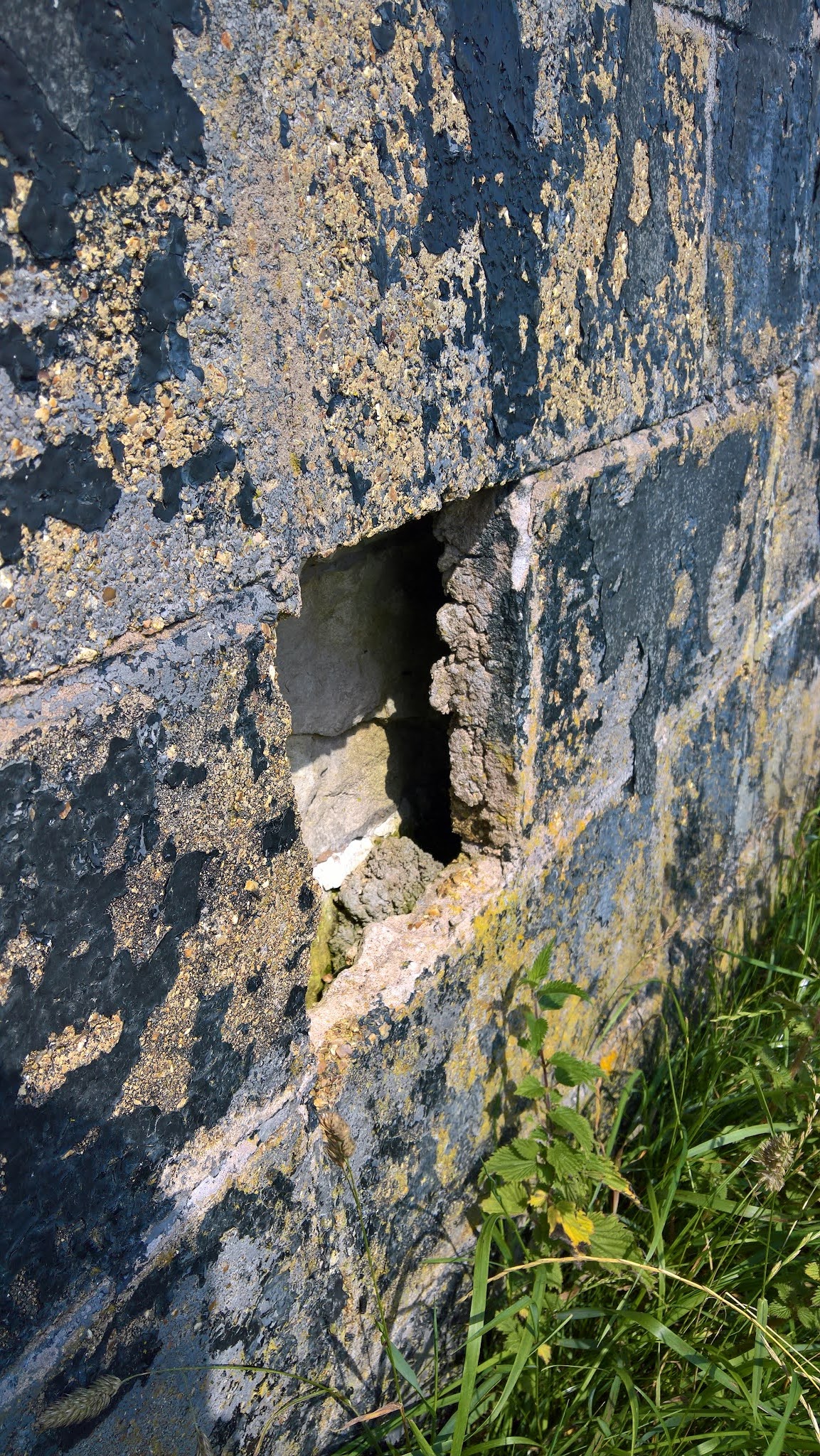
From most angles, the sea mark looks like a stone tower, albeit of curious shape, possibly Masonic or even anti-Masonic, for which see reference 3 for someone else's arty snap. But finding this hole, maybe it is a fake? Maybe what you see is just thin facing stone and the structure is mainly rubble concrete, after the way of many medieval castles?

In need of a paint job. The heritage people have been a bit slack.

Nearly 360° vision, just the odd interruption.

And so, rather appropriately, the sea mark closes this year's holiday to the Isle of Wight.

Reference 1: https://psmv4.blogspot.com/2021/08/carisbrooke-castle.html.

Reference 2: https://pumpkinstrokemarrow.blogspot.com/search?q=ashey+down.

Reference 3: https://psmv2.blogspot.com/2015/07/tweet-tweet.html.

Reference 4: https://psmv4.blogspot.com/2021/07/monster-mushrooms.html. This was also the day of the monster mushrooms.

Carisbrooke Castle

For the heritage outing for our recent holiday in the Isle of Wight, we opted for Carisbrooke Castle, getting there via the scenic route, the one that takes one past the Hare & Hounds at Downend, a place we have eaten at at least one, getting, as I recall, huge portions of not very nice ham. Possibly fresh out of a tin. Moved on a bit since the snap above was taken.

As it turned out, a hot day. One was glad of a bit of shade from time to time.

We spent quality time in the privy garden, otherwiseth  'Princess Beatrice Garden, designed by a TV gardener, this pretty Edwardian-style garden is based on the original garden retreat of Queen Victoria's daughter'.  The first thing to strike us on arrival was the thistle above, covered in bees and such like.

Then we came across a statue of the war horse 'Warrior' of reference 3,a real war horse, not to be confused with the war horse of the play. Not very big at all and not offensive in the way of a lot of modern outdoor sculpture, but I would have preferred it not to be there. Not a variety of sculpture that I care for, certainly not in ornamental gardens.

The chap on the horse, illustrated in snap of the painting by one Alfred Munnings above, is J. E. B. Seely, 1st Baron Mottistone, who as an acting Brigadier General was given command of the Canadian Cavalry Brigade during a good part of the first world war, and is sometimes remembered for having, in 1918, led one of the last old-style cavalry charges against the Germans. His family were really from up north, but had a lot of land in the Isle of Wight, where Mottistone is to be found in the south, a little to the west of Brighstone.

We visited the chapel, St. Nicholas-in-Castro, with this particular incarnation  completed after the first world war and rededicated as the County War Memorial in 1929. It previously been dedicated to the memory of Charles I. With his retaining centre stage striking me as rather odd: a king executed for treason (even odder) gracing a memorial to those who died fighting for their country in the two world wars.

While Princess Beatrice's husband died of cholera while fighting the Ashanti in West Africa (dark brown, low centre), who took a dim view of our stopping them from grabbing a chunk of the Gold Coast, at that time the property of another, weaker tribe. They needed an outlet to the sea.  And I imagine that, like the Romans before us in Asia Minor, we were only too happy to intervene in affairs of this sort, confident that we would end up on top.

Onto the museum where, inter alia, there was a selection of relics, some of them taking the form of a lock of someone's hair built into a finger ring, or perhaps, as above, a small paper weight.

There was also a display about Little Jane, who died devoutly at Brading, where her cottage is still to be seen, a little run down as I recall. The sort of person, had she lived fifty years earlier, who might have been a worthy subject for Clarissa's charitable and pious activities.

Back into the Privy Garden where benches under a low, spreading tree made a very suitable place for a picnic. Where we were joined by a Ryde lady who had, we learned, had spent years messing around in boats in and around the Greek islands. Afterwards, I wondered how on earth such people occupied all their time when they weren't drinking or conducting affairs with their friends' partners. Perhaps it is a life which suits people who are both sociable and lazy? As opposed to the people who go in for round-the-world solo stunts. From where I associate to the lady who admitted to why-am-I-doing-this moments while she rode out enormous storm waves somewhere in the southern ocean. The sort of thing to be glimpsed among the razzmatazz of reference 4.

Thought about scoring this organ, a companion piece to piano 16 at Osborne, the palace up the road, noticed at reference 5. But being an organ it was too much of a stretch.


We wondered whether the spreading tree was a walnut. Inspection by Bing this morning suggests that it may well have been. But I would have preferred to have had a shot of the leaves from above to be sure.

The walk around the battlements, some of which are visible in the snap above, was one way and looked as if once you had started you had to keep going. Nervous about vertigo I decided against and we settled for a walk around the outside of the walls of this serious castle, with its serious gun emplacements. Lots of grass hoppers and lots of pyramid orchids. BH spotted a rabbit.

We also had what seemed to be a mutant conker tree. Spikes not right for a regular conker, but Bing not helpful so far, Wikipedia does not admit to varieties and further investigation is deferred.

On the way home we took in the famous Ashey Down Sea Mark. Snaps to follow.

Reference 1: https://www.english-heritage.org.uk/visit/places/carisbrooke-castle/.

Reference 2: https://en.wikipedia.org/wiki/Princess_Beatrice_of_the_United_Kingdom.

Reference 3: https://onthewight.com/war-horse-warrior-remembered-statue-carisbrooke-castle/.

Reference 4a: https://www.youtube.com/watch?v=24FWd--0l9g.

Reference 4b: https://www.vendeeglobe.org/en.

Reference 5: https://psmv4.blogspot.com/2019/07/piano-16.html.